 Should I Buy It?

What you think you remember from a trip
Why memory doesn’t store — and how to build the right system to compensate
The week after a trip, you remember everything. The rooftop dinner, the light that evening, the conversation with the driver. Three months later, what remains is the frame — “it was great, I loved it” — and a few floating images, context-free. A year later, you find a photo and realize you had completely forgotten that place.
This isn’t negligence. It’s biology.
Ebbinghaus measured it in 1885: without active recall, memory degrades exponentially. 70% of an experience forgotten within 24 hours. ~80% within a week. These numbers are often cited, rarely understood. Because what Ebbinghaus measured was the worst case — meaningless syllables, no emotion, no context. His numbers don’t describe our trips exactly. But they describe what happens to them anyway.
Act I — Memory doesn’t store. It reconstructs
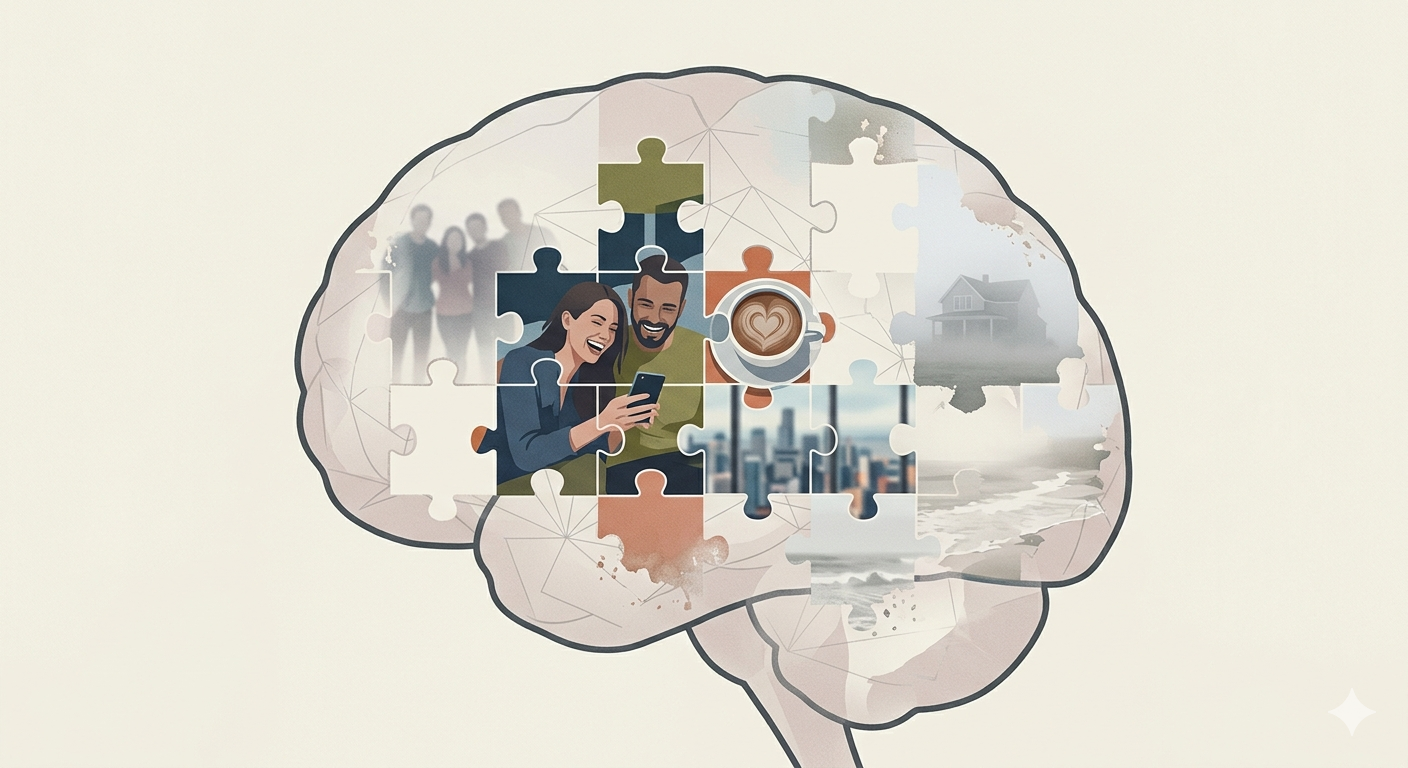
Frederick Bartlett, in 1932, attacked Ebbinghaus’s method at its root. By eliminating meaning from the data, Ebbinghaus hadn’t isolated memory — he had studied a laboratory artifact. Real memory, Bartlett argues in Remembering, isn’t reading a file. It’s active reconstruction from incomplete schemas.
His experiments with a Native American tale — “War of the Ghosts” — demonstrated this: subjects don’t recall texts, they reconstruct them. They fill in gaps, normalize inconsistencies, bring the foreign back to the familiar. They impose meaning where there was ambiguity. What Bartlett called the “effort after meaning” — the brain’s effort to give shape to what resists it.
This principle has crossed a century of research without being refuted. Daniel Schacter, in The Seven Sins of Memory (2001), catalogued seven ways memory betrays us: transience (progressive forgetting), absent-mindedness (inattention during encoding), blocking (a name on the tip of your tongue), misattribution, suggestibility, bias, persistence. All are symptoms of the same mechanism: memory is not an archive, it’s a dynamic reconstruction system, guided by existing schemas and altered with each recall.
Endel Tulving (1972, 1983) refined the map. He distinguishes two types of long-term memory: semantic memory — general facts, detached from the context of acquisition (Paris is the capital of France) — and episodic memory — memories tied to a time, a place, a personal experience (the meal at that bistro on a March evening). Episodic memory enables what he calls “autonoesis”: subjectively re-experiencing the past, mental time travel. It’s what makes travel memories valuable.
And it’s the one that degrades fastest.
Brainerd and Reyna (Fuzzy Trace Theory) showed that the brain encodes two traces in parallel: the verbatim trace (precise details — the restaurant’s name, the wall’s color, exactly what was said) and the gist trace (the semantic essence — it was a good dinner, with nice people). Verbatim traces fade first and fastest. What you “lose” from a trip is precisely that: the temple’s name, the address, the taxi anecdote, the exact thought you had watching that sunset. What remains: the general emotion, the narrative frame. The metadata disappears. The compressed file stays.
Act II — Memory has always needed a group
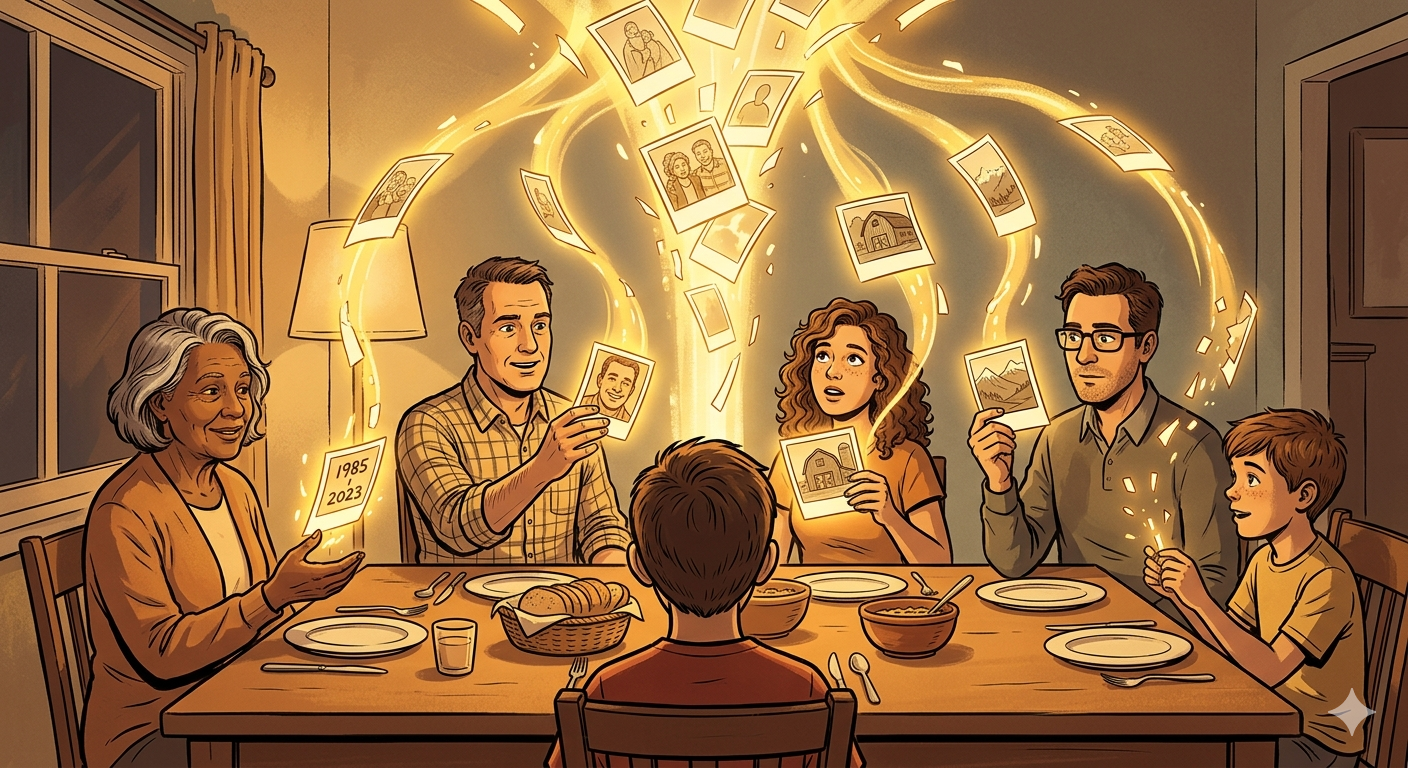
Maurice Halbwachs, French sociologist, established in 1925 something no one questions today: individual memory doesn’t exist outside the groups that support it.
“The facts we recall may be strictly personal, but the frameworks we insert them into are always provided by society.”
A childhood memory doesn’t survive because the brain stores it well. It survives because the family talks about it, ritualizes it, confirms it at every gathering. When the group disappears — distant family, lost friendships — the memories fade with it. Collective memory isn’t a sociological metaphor: it’s the actual mechanism by which individual memories become durable. They need a social framework to hold.
Cultures without writing had understood this structurally. Milman Parry, in the 1930s, recorded illiterate Yugoslav bards who produced epics of several thousand verses. He demonstrated something unexpected: these bards weren’t reciting. They were recomposing at each performance, assembling memorized formulaic blocks according to audience expectations and the evening’s events. Walter Ong, in Orality and Literacy (1982), generalized this: in oral cultures, any knowledge not regularly performed disappears. To revise is to perform. To perform is to reconstruct. What we now call the “testing effect,” the Greeks had institutionalized as a condition for knowledge’s survival.
Writing changed this relationship to forgetting — by making conservation without recall possible. The library as dead memory. And with digital platforms, we thought the problem had been definitively solved.
We were solving the wrong problem.
Instagram, Google Photos, Facebook Memories play the role that family around the table once played: the social recall function, the group confirmation that transforms a trace into an anchored memory. But there’s a structural difference. The human group chose what it recalled according to complex affective logic. The algorithm chooses according to engagement metrics. Your memory of 2019 doesn’t resemble what you actually lived — it resembles what the algorithm decided to surface.
And behind this difference, a vulnerability that Sparrow, Liu, and Wegner documented in 2011 in Science: the Google Effect. When we know that information is stored somewhere accessible, we no longer encode it biologically. The brain delegates. But if the machine disappears — and machines do disappear: MySpace (2006-2011), Google+ (2018), Geocities (2009) — the memory disappears with it.
Pierre Nora called these lieux de mémoire (memory sites): the material and symbolic places where a society deliberately conserves its memory. Digital platforms are accidental memory sites. They collect by design; they don’t preserve by mission.
Act III — The right architecture
Andy Clark and David Chalmers posed a simple question in 1998: where does the mind stop?
The intuitive answer: at the skin, or the skull. Their answer: “it ain’t necessarily so.”
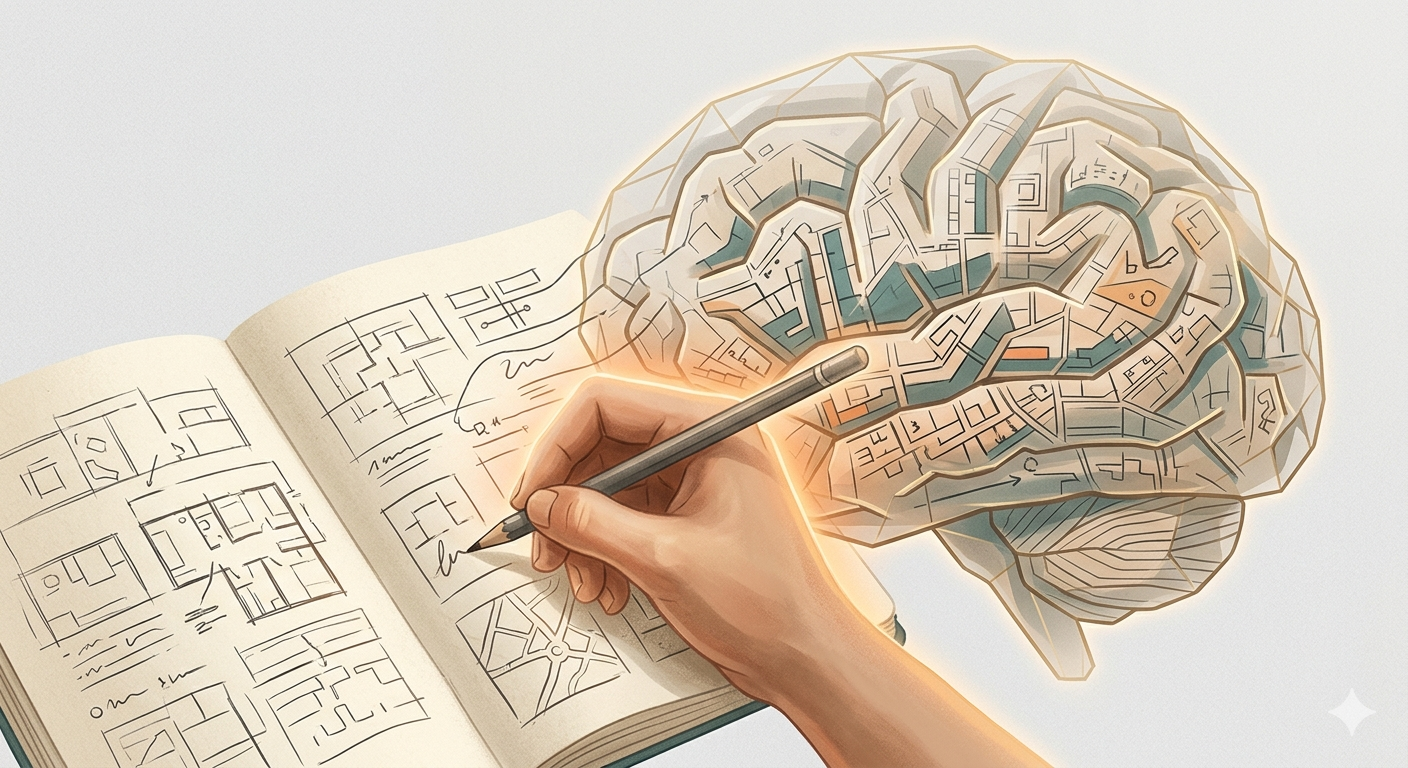
Their argument — the Extended Mind thesis — starts from a concrete case. Otto has Alzheimer’s. He writes everything in a notebook and consults it before every decision. Otto doesn’t consult his notebook: his notebook is his memory. Functionally, constitutionally, there’s no difference between Otto with his notebook and Inga accessing her intact biological memory. The difference isn’t in kind — it’s in location.
The parity principle they formulate: if a part of the world performs a cognitive function that, if performed in the head, would be recognized as part of the cognitive process, then that part of the world is genuinely part of the cognitive process. This isn’t a metaphor. It’s a precise philosophical thesis with necessary and sufficient conditions.
In 2025, Clark himself co-authored an article in Synthese — “ChatGPT, extended: large language models and the extended mind” — applying his own thesis to LLMs. The loop closes.
A bot that receives your travel voice notes doesn’t store data on your behalf. If the conditions are met — availability, accessibility, trust in accuracy — it is a part of your memory. But there’s a nuance that Clark and Chalmers hadn’t anticipated. The bot does more than Otto’s notebook. It narrates. It doesn’t store facts — it reconstructs a timeline, identifies highlights, generates a narrative. It’s a cognitive extension of a new kind.
But the architecture isn’t neutral.
Telling a friend consolidates memories — but also distorts them. Pasupathi (2001) showed that people remember what they said, not what they experienced. Social narration optimizes for communicability: we minimize idiosyncratic details (private, hard to communicate), we amplify what makes sense for an interlocutor. The memory becomes more shareable and less personal. Barber & Mather (2014) confirmed this episodic-to-semantic shift: narrating to a human produces a more social, less faithful narrative trace. And this is what memory reconsolidation enables at each recall — each narration reworks the trace.
Narrating to a bot with no social reaction, no expectations, no judgment: idiosyncratic details have no reason to be filtered. The strange thought you wouldn’t have told a friend, the anecdote too local to interest anyone else, the precise texture of a moment — all of it can stay.
There’s also the question of when. Stickgold and Walker showed that the first night after an experience is a critical window for memory consolidation. The brain reactivates and reorganizes traces during slow-wave sleep. Capturing before sleep isn’t a methodological preference — it’s aligning with the biological mechanism.
And the question of how. Roediger and Karpicke published numbers in 2006 that change how we think about note-taking. Four successive re-readings of a text: 56% forgotten after a week. One reading then three acts of active recall: 13% forgotten. The effort of reconstruction — narrating rather than archiving — consolidates better than passive re-reading. This isn’t a paradox: each recall act reconstructs the trace, strengthens synaptic connections, makes the memory more resilient. Telling the bot about your day isn’t just capture — it’s already active recall. The first of a series.
Act IV — Vivid Memories: memories in multiple forms

Cepeda et al. calibrated optimal recall intervals: to retain something for a year, you need to space revisions over several weeks, with increasing intervals. This isn’t a constraint — it’s an architecture. And this architecture has a property often ignored: it works even better when the forms of recall are different.
Research on multimodal encoding — including Richard Mayer’s work on multimedia learning (2001) and studies on contextual memory — shows that the same memory anchored in multiple formats creates multiple access paths. A memory recalled through a photo, then a text, then a physical object, then a conversation isn’t recalled four times — it’s anchored in four different contexts, making it accessible by four distinct routes. The richness of encoding, not just its frequency.
What this says about everyday objects: the coffee mug with the best moments from a trip, seen every morning, is an accidental spacing effect. It creates a regular recall opportunity, effortlessly, in a different context from actively consulting a note. The fridge magnet, the postcard pinned to the wall, the phone’s cover photo — these objects aren’t nostalgia. They’re passive recall triggers, at irregular intervals, doing exactly what Cepeda recommends: reactivating the trace over time.
The difference between those objects bought at an airport and what we could build: the former are generic. The latter would be built from your own words, your own moments, your own phrases. The memory book chaptered by day — generated from your travel voice notes. Your best travel quotes in a visual, phrased in your exact words. Your key moments printed on a mug, a magnet, a card. Not monument photos. Living text, reconstructed from the raw trace.
That’s the thesis behind Vivid Memories — the candidate name for the complete ecosystem. Memory Logger captures. Memory Studio transforms into outputs. Vivid Memories designates what all of this produces: vivid memories — not in the sense of “clear as photographs,” but in the Latin sense of the word: vivus, alive. Memories that keep living because they’re regularly reactivated, in multiple forms, across varied contexts.
The idea isn’t new. It’s as old as the first humans who carved cave walls. What’s new is that we can now automatically generate these supports from voice — from the raw, unfiltered narration, captured at the right moment.
What this changes, concretely
Memory has never been a storage problem. This is what all this research, from Bartlett to Clark via Halbwachs, converges on.
Memory has always been an architecture problem: when you capture, how you narrate, where you store, how you recall, and how many forms you give to what you want to keep.
Platforms solved storage — and created dependency. Note-taking apps solved capture — and created friction. No one has yet solved recall outside of academic flashcards.
That’s the problem Vivid Memories tries to frame differently. Not another journaling app. A personal memory architecture — from zero-friction voice capture to everyday objects that reactivate memories without you having to do anything.
Halbwachs hadn’t anticipated Notion. But he had already explained why we needed it. And he had already said that memory survives in objects, rituals, and frameworks that the group maintains. We can build those frameworks ourselves.
Tonight, after this trip
Science converges on three levers. You don’t need all three at once — just one already changes something.
1. Narrate before sleeping, out loud. Not writing. Speaking. Oral narration recovers details that writing filters out: the tone, the hesitation, the anecdote you wouldn’t have deemed “important.” Ten minutes is enough. A voice memo, a Telegram bot, whatever the medium — what matters is doing it before the first night, while the verbatim traces are still intact. After that, the frame remains. The details are already gone.
2. Store somewhere that belongs to you. Not Instagram. Not Google Photos. A tool where you own the data — Notion, Obsidian, a simple folder. Memory shouldn’t reside where someone else decides what to surface, and when. Algorithmic recall isn’t neutral: it selects by engagement, not by what matters to you.
3. Create a physical object from your own words. Just once, a few weeks after the trip. A printed doc, a pinned page, a mug with your own phrases — not monument photos. The physical object does what the app doesn’t: it creates passive recall, in a different context, without any decision on your part. That’s the spacing effect without effort. And because it’s built from your raw narration, not from an algorithmic selection, it’s your memory — not an editorial version of it.
Sources: Ebbinghaus (1885), Bartlett (1932), Tulving (1972, 1983), Brainerd & Reyna (Fuzzy Trace Theory), Schacter (2001), Halbwachs (1925, 1950), Nora (1984), Sparrow, Liu & Wegner (2011), Clark & Chalmers (1998), Smart, Clowes & Clark (2025), Pasupathi (2001), Barber & Mather (2014), Stickgold & Walker (2004, 2006), Roediger & Karpicke (2006), Cepeda et al. (2006), Mayer (2001), Milman Parry (1930s), Ong (1982)