 Should I Buy It?
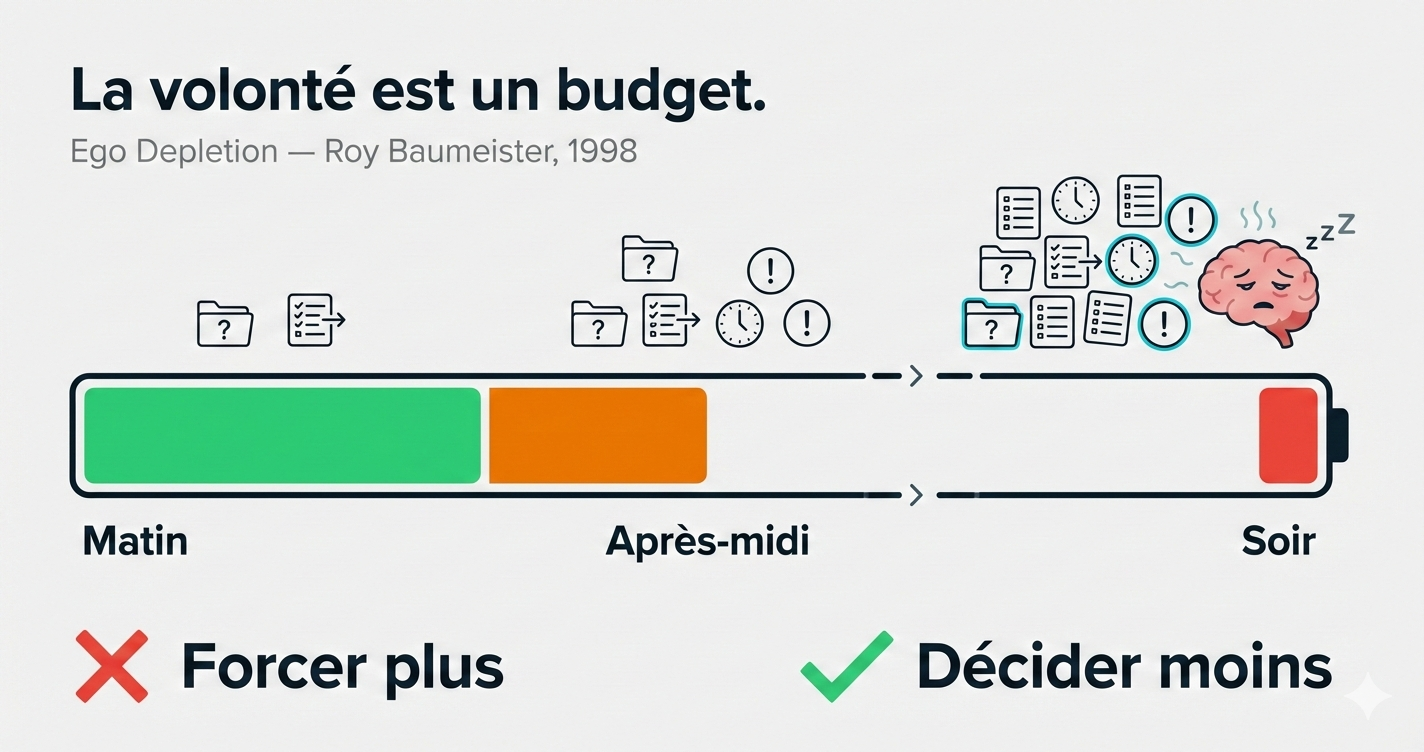
Every act of self-control — resisting a temptation, making a decision, sustaining concentration — draws from a mental reserve. When that reserve runs low, the quality of subsequent decisions deteriorates. That’s the central intuition of ego depletion. But the science is more nuanced.
Origin
Roy Baumeister, psychologist at Case Western Reserve University, published a landmark study in 1998 in the Journal of Personality and Social Psychology: “Ego Depletion: Is the Active Self a Limited Resource?”
The experiment became famous. Participants who had to resist chocolates (eating radishes instead) gave up on an unsolvable puzzle twice as quickly as those who hadn’t had to resist. The self-control used for the chocolates had “depleted” a shared resource, reducing the capacity to persist on the next task.
Baumeister compared willpower to a muscle: it tires with use but can also be strengthened through training.
The Theory
Ego depletion proposes a limited-resource model for self-control. Each act of control — resisting temptation, making a hard decision, maintaining focus despite distraction — consumes part of this resource. When the resource is low, people shift to “default” mode: simpler, faster, more impulsive decisions.
The natural extension is decision fatigue: the phenomenon applies not only to pure self-control but to any decision. A striking study by Danziger, Levav and Avnaim-Pesso (2011) analyzed 1,112 parole decisions by Israeli judges: 65% favorable rulings at the start of sessions, near 0% just before lunch breaks, back to 65% after. The judges weren’t becoming “harsh” — they were defaulting to the safe decision (denial) when depleted.
Obama’s anecdotes (“I don’t want to decide what I eat or wear — I have too many real decisions to make”), Zuckerberg (same grey t-shirt every day), or Steve Jobs (black turtleneck + jeans always) illustrate a deliberate strategy of conserving “decision budget.”
The Replication Crisis (2016)
Ego depletion suffered a major scientific blow in 2016. Hagger et al. organized a pre-registered replication across 23 different laboratories with 2,141 participants — the effect appeared non-significant (d = 0.04). In 2025, a second replication across 36 laboratories (3,531 participants) confirmed the absence of a robust effect (d = 0.06).
Several interpretations compete:
- The original effect was an artifact of specific experimental conditions.
- The manipulations used in replications were too weak to genuinely deplete the resource.
- The mechanism is real but conditional — it depends on individual factors (beliefs, motivation, context).
Carol Dweck and colleagues (Job, Dweck & Walton, 2010) showed something striking: ego depletion only occurs in people who believe willpower is limited. In those who believe willpower is unlimited, no performance decrease is observed after demanding tasks.
What Remains Solid
Even amid uncertainty about the exact mechanism, several points are robust:
Cognitive fatigue is real. After several hours of intense mental work, decisions become simpler, faster, less rational. This isn’t Baumeister’s ego depletion stricto sensu, but it’s a consistent observation.
Willpower can be trained. Muraven, Baumeister & Tice (1999) showed that regular self-control exercises (monitoring posture, regulating mood) improve overall self-regulation capacity — like a muscle strengthened through practice.
Beliefs matter enormously. What you believe about your willpower affects your actual performance. People with a growth mindset about willpower show fewer signs of decision fatigue.
Reducing micro-decisions is a valid strategy. Whether you call it ego depletion or cognitive fatigue, delegating repetitive decisions to systems — routines, habits, automations — frees mental bandwidth for decisions that genuinely warrant it.
Nuances and Limits
The “draining reservoir” model is probably an oversimplification. The current view is closer to a conservation mechanism: the brain doesn’t exhaust a resource, it chooses to conserve effort when it perceives reserves are dropping — based on beliefs, motivation, and the perceived value of the task.
The core intuition — that it’s better to make important decisions early in the day, reduce repetitive micro-choices, and build systems that decide on your behalf — remains useful as a mental model, even if the underlying mechanism is more complex than a simple mental energy tank.
Sources: Baumeister et al. (1998). Journal of Personality and Social Psychology · Danziger et al. (2011). PNAS · Hagger et al. (2016). Perspectives on Psychological Science · Job, Dweck & Walton (2010). Psychological Science · Muraven et al. (1999). Journal of Social Psychology