 Should I Buy It?
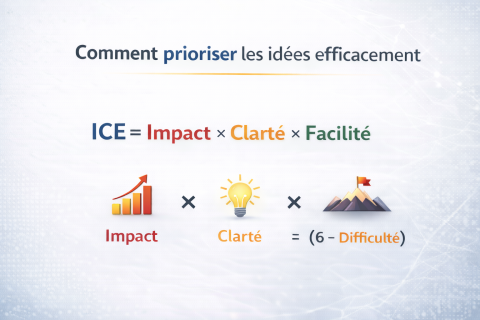
The ICE Score is a rapid prioritization tool. Each idea receives a score on three criteria, multiplied together. The result allows you to objectively compare very different ideas without endless debate.
Origin
Sean Ellis, founder of GrowthHackers, created the ICE Score in 2009 for growth teams juggling dozens of experiments to launch simultaneously. The principle: escape consensus and quantify intuitively the value of an idea before investing time in it.
Original ICE: Impact × Confidence × Ease (each criterion scored out of 10).
The Theory
Original ICE:
- Impact (1-10): What potential effect on the business or growth?
- Confidence (1-10): How sure are you it will work? (based on data, feedback, experience)
- Ease (1-10): How easy and fast is it to implement?
The multiplication creates an amplification effect: an idea that’s very easy but low-impact stays low-priority. A high-impact idea that’s very difficult to execute also drops in ranking.
Solo adaptation (without user data):
- Impact (1-5): same
- Clarity (1-5): replaces Confidence
- 6 – Difficulty (1-5): replaces Ease (negated so high = easy)
Formula: Impact × Clarity × (6 – Difficulty)
In Practice
Why Clarity instead of Confidence?
In a solo and voice-based context (capturing ideas on the fly), there’s no user data. The real question isn’t “will it work?” but “do I really know what I want to build?”
- High Clarity = the idea is well-defined, I can start tomorrow
- Low Clarity = it’s still vague, I need to figure out what it actually means concretely
Confidence filters out risky bets. Clarity filters out immature ideas. For a solo operator, this is more useful — a vague idea will waste time in definition rather than execution.
Why Difficulty instead of Ease?
Same concept, phrased differently. On a 1-5 scale, Ease of 5 = very easy. 6 – Difficulty with difficulty of 1 gives 5 = same result. The “Difficulty” framing is more intuitive to score: you naturally think about the effort required, not abstract ease.
Application in the Idea Logger:
The Telegram → n8n → Notion automation calculates the ICE Score automatically at capture. Top-scored ideas surface to the top of the Notion list. A score threshold triggers a notification to revisit the idea at the right moment.
Nuances and Limits
The ICE Score is subjective by design — two people will score the same idea differently. That’s not a bug, it’s a feature: it forces you to make explicit your evaluation criteria rather than letting priority be decided by mood.
Real limits:
- Sensitive to recency bias (yesterday’s idea always feels more urgent)
- Multiplication creates non-linear gaps: 5×5×5 = 125, but 4×4×4 = 64 — one point less on each criterion halves the score
- Doesn’t capture dependencies between ideas (idea A that unlocks idea B)
Sources: GrowthHackers — ICE scoring · Sean Ellis on Twitter