 Should I Buy It?
Aristotle didn’t foresee Claude. But in defining poiesis, praxis, and phronesis, he had already traced the boundary between what AI can take and what it cannot reach — at least not yet.
The three terms
Poiesis (from the Greek poiein, to make): any action oriented toward an external result. The value is in the output. Once the object is produced, the activity has no further reason to exist. Writing a report, coding a function, analyzing data — these are poiesis. AI excels here.
Praxis (from the Greek prassein, to act): any action whose value resides in the act itself. The activity is its own end. Healing, deliberating, teaching, creating with someone — these acts have meaning independently of their output. AI can imitate, not embody.
Phronesis (practical wisdom): the capacity to decide rightly in complex situations without pre-established rules. Not making, not acting — judging. Directing without executing. This is the virtue that governs praxis — it can only be acquired after years of execution.
“Action has its end in itself, while production has its end in an object separate from the activity.” — Aristotle, Nicomachean Ethics
A hierarchy of dependency
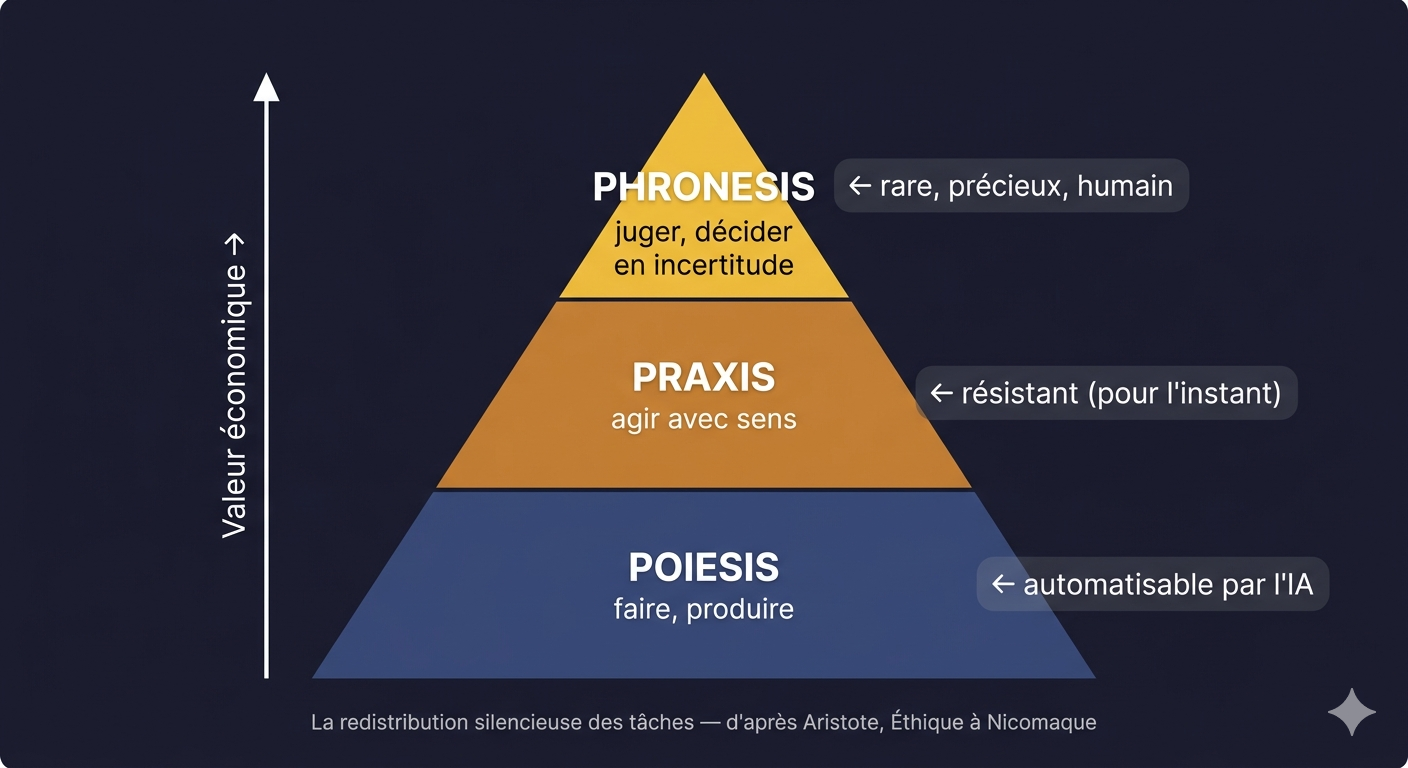
Each level presupposes the one below it:
- Phronesis presupposes praxis: you cannot judge under uncertainty without first knowing how to act with meaning — good judgment operates within action, not above it.
- Praxis presupposes poiesis: meaningful human action always unfolds in a material world that must first be built.
In Aristotle this is explicit — phronesis is the virtue that governs praxis, it cannot exist without it. This isn’t an abstract hierarchy of value — it’s a hierarchy of dependency. To enter praxis, you must have passed through poiesis. To enter phronesis, you must have exhausted praxis.
Application to the AI agent era
AI automates poiesis at unprecedented speed. Autonomous agents of 2025-2026 no longer reason at the task level — they reason at the level of entire workflows.
This shift reveals a hierarchy of what human beings can entrust to something other than themselves:
| Mode | Delegable? | Why |
|---|---|---|
| Poiesis | Yes | The output is separable from who produces it |
| Praxis | No | The value is inseparable from human presence |
| Phronesis | No (for now) | Judgment presupposes character and accumulated experience |
What this table says is not a consolation — it’s a design constraint. Poiesis was delegable to the slave, the tool, the machine. Praxis is not: it implies the character of the one who acts. Phronesis even less so: it’s the capacity to judge rightly in situations where no rule is sufficient.
The third economy taking shape is that of phronesis: not that of those who make (poiesis, automatable), not that of those who act with presence (praxis) — but that of those who judge with enough competence and context to direct what agents execute.
Aristotle didn’t foresee Claude. But he had already anticipated what we would delegate to it.
Sources
- Aristotle. Nicomachean Ethics (~350 BC) — Books VI and X
- Arendt, H. (1958). The Human Condition
- Frankl, V. (1946). Man’s Search for Meaning
- Frey, C.B. & Osborne, M.A. (2013). The Future of Employment. Oxford Martin School