 Should I Buy It?
Introduction — The loop I took a while to name
I spend Sunday mornings discussing ancient Greek philosophy with an AI.
We talk about Aristotle, about what he called theoria — pure contemplation, thinking for the sake of thinking, without any practical purpose. We drift into the economics of work, into what AI is actually automating, into what “living well” means in 2026. And in the meantime, this conversation becomes an article. The article becomes posts. The posts build an audience. The audience builds credibility. The credibility gives me time to spend more Sunday mornings discussing Greek philosophy.
For a long time, I would have felt guilty. Wasting time on philosophical rambling when I should be producing.
I stopped feeling guilty the day I understood that this isn’t wasted time — it’s fuel. And that I had built, without quite planning it, a system that turns this fuel into output without forcing me to choose between thinking and producing.
Aristotle called it theoria. Naval Ravikant would call it Work as Play. I call it Ekenor — from Old Norse auka (to augment) and nor (direction). Augmenting in the direction you choose.
Here’s what I’m building, and why. But first — what I walked away from.
In January 2026, I abandoned the project I’d been working on for a year. A large mobile application, a single big bet, a lot of energy concentrated on one thing. I stopped everything to restart with a radically different strategy: not one project, but a portfolio. Not a bet, but an accumulation.
Then I read Naval. And I realized that what I was building had a name: Permissionless Leverage. Naming a concept changes something — it turns an intuition into an intentional direction.
Wizards and muggles
There’s a gap widening right now, and most people don’t see it yet.
It’s not the gap between rich and poor — everyone talks about that one. It’s not the gap between educated and non-educated — that one is actually shrinking.
It’s the gap between those who control leverage and those who are controlled by it.
Naval Ravikant put it better than anyone: “Forget rich versus poor, white-collar versus blue. It’s now leveraged versus un-leveraged.”
Oussama Ammar recently reframed it in a way that fits perfectly: there are wizards and muggles. Muggles live in the same world as wizards — but they don’t see the magic. To them, what a wizard does looks like the inexplicable, like luck, like cheating somehow. Wizards have learned to wield forces that others are subject to without understanding them.
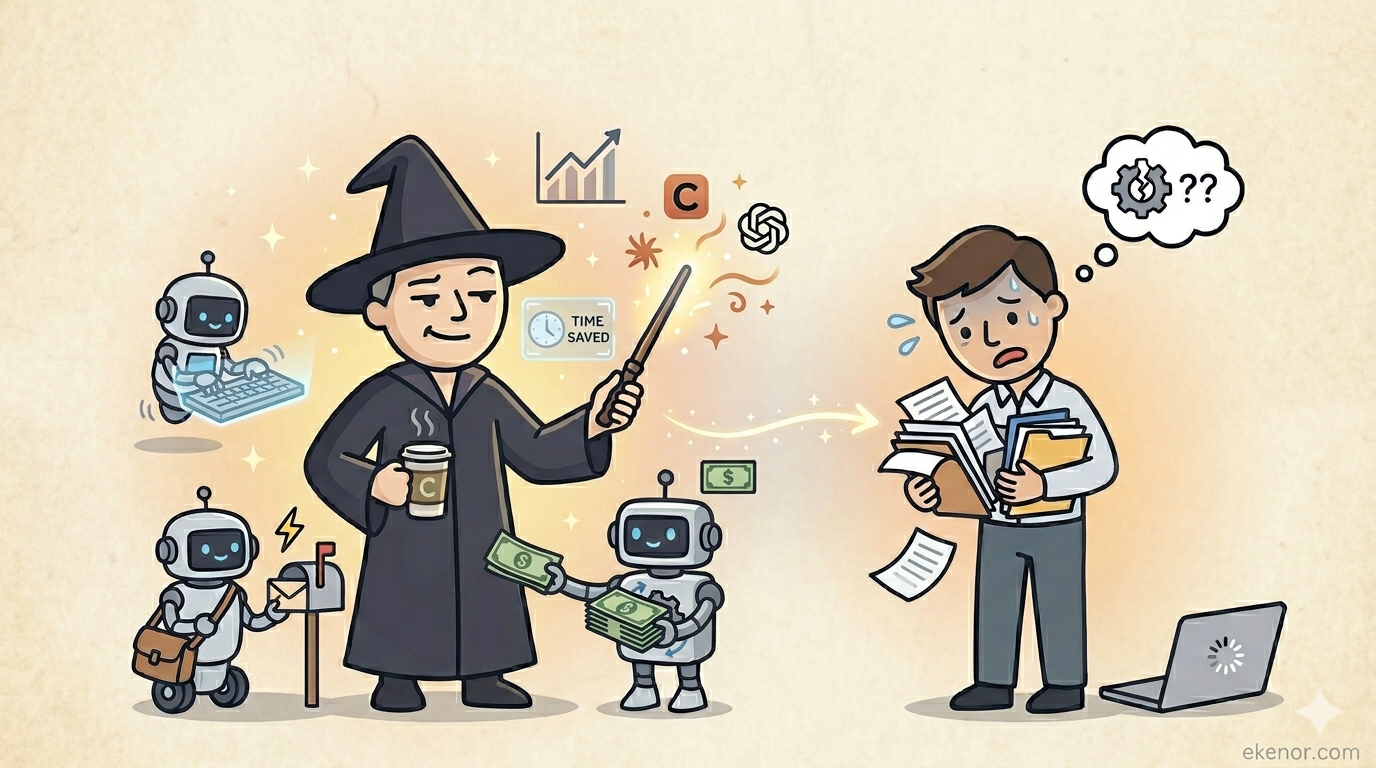
In 2026, the magic is called AI. And like in Harry Potter, the world doesn’t get easier for muggles when magic spreads — it just gets more opaque.
What’s playing out is a bifurcation. On one side, those who understand the mechanisms and build their own leverage — digital assets that work for them, that scale without permission, that compound. On the other, those who wait and see, for whom the system runs faster and faster without them holding any of it.
The gap isn’t linear. It’s exponential — because each lever deployed frees up time to build another. The first automated project creates margin for the second. Accumulated credibility accelerates the third. Meanwhile, those who haven’t started are chasing a train that isn’t waiting for them.
Building permissionless leverage means choosing to play the game instead of being played by it.
This isn’t new — and why now
This bifurcation didn’t start with AI — it just changed its face.
James Dale Davidson and William Rees-Mogg predicted it as far back as 1997 in The Sovereign Individual: networked technology would allow individuals to progressively extract themselves from centralized systems — nation-states, large corporations, financial intermediaries — and build their own economic sovereignty without asking permission from anyone. Their thesis: human history is punctuated by technological ruptures that redistribute power. The printing press weakened the Church. Gunpowder reduced the effectiveness of knights. The internet was going to do the same to centralized structures.
They were right about the direction. The first internet millionaires of the 2000s — dropshippers, app developers, content creators — had already understood something the majority hadn’t seen: that you could build digital assets that scale with zero marginal cost, without permission, without intermediaries. But you needed to know how to code, or have capital, or both. The technical barrier to entry was real.
Behind that barrier was a deeper logic: owning your code, your data, your audience means no longer depending on someone else to exist economically. No platform that can cut your access overnight. No employer whose cost-cutting budget can make you disappear with one email. That’s digital sovereignty in the Davidson & Rees-Mogg sense — not autarky, but structural independence.
What changes in 2026 is that threshold. Generative AI dropped it almost instantly. Building a functional tool, an automated workflow, a content site no longer takes years of technical training. You need to know what to ask.
But windows of opportunity always work the same way: at first, very few pioneers because it’s hard — then it democratizes, the advantage dilutes, scarcity shifts. It’s already shifting: toward judgment, toward accumulated trust, toward compound reputation in Naval’s sense — the long-term game. The longer you wait, the more of a head start the early movers have, and the more effort it takes to catch up.
The accessibility window is open. It won’t stay open indefinitely.
The three levers (and why two of them don’t interest me)
Naval distinguishes three forms of leverage in human history.
Labor leverage — the oldest. Managing people. Building a team, recruiting, managing. For every person you convince to work for you, you multiply your capacity for action. Powerful. Also the most energy-intensive to deploy, the slowest to build, the most fragile to maintain.
Capital leverage — the 20th century. Making money work instead of people. Thousands of billionaires were created by this mechanism. Problem: to access capital, you need to convince someone to entrust it to you. Capital requires permission.
Zero marginal cost products — our era. Code, media, books, podcasts. An article written once can be read ten million times. An automated workflow can handle a thousand requests without me lifting a finger. An online tool can be used by a hundred thousand people simultaneously.
The fundamental difference: no one needs to authorize me to deploy these levers.
“Every great software developer now has an army of robots working for him while he sleeps.”
The army of robots is available to anyone who knows what to ask them.
Permissionless leverage means putting the work on autopilot while you do what you love.
The nuance Naval doesn’t have
Naval says: do what you love and the money follows.
That’s true. But Naval says this after succeeding with AngelList. He already had the reputation-capital when he formulated that advice.
He admits it indirectly himself: Specific Knowledge is the knowledge that can’t be taught but can be learned. And learning it takes time. Time that, in his version, he had the luxury to take because he’d already built a solid financial foundation.
For me, the sequence is different. I’m not building reputation first, then revenue. I’m building both in parallel. Minimum capital to have the time to do what I love AND build the Specific Knowledge that will make what I love monetizable over the long term.
The destination is the same. The sequence is different.
The complete loop
Aristotle had a term for the life he considered the highest: bios theoretikos — the contemplative life. Thinking for the sake of thinking. Exploring for the sake of exploring. Without external purpose. He reserved it for philosophers who had slaves to handle everything else.
I don't have slaves. I have AI agents working while I think.
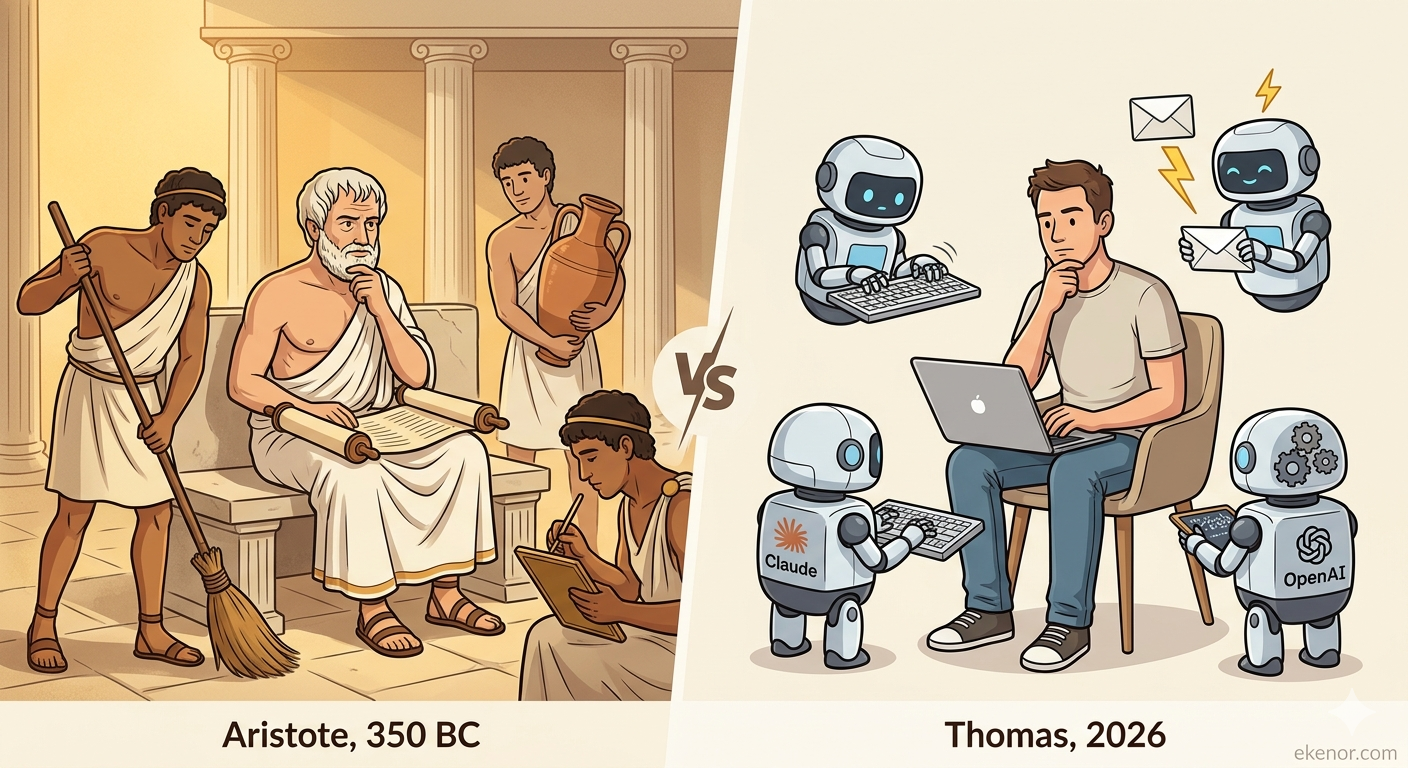
I contemplate — videos, books, conversations, subjects that intrigue me. What I would have done for free anyway. This intellectual wandering that active life slowly erodes.
The system captures — conversations become articles, articles become posts, posts build an audience. AI handles the poiesis — the production, the formatting, the publishing. I handle the judgment and the intention.
The output works — audience, credibility, revenue. The levers run while I think about something else.
Revenue frees time — to contemplate more. To build the next lever. To spend more Sunday mornings discussing Greek philosophy without guilt.
Intellectual wandering doesn't disappear — it becomes useful.
What I’m building concretely
Here’s what this looks like in practice.

Projects — an idea capture and prioritization system (Ideas Logger), a desktop focus tool (Smart Focus), a browser extension to decide before buying (Should I Buy It), a task management system (Todo Manager). Each project is an hour invested that keeps running afterward.
Documented concepts — every idea I learn, I structure. A note, an article, a link. Not isolated notes: a knowledge graph where each concept points to the projects that apply it, the tools that stem from it, the articles that analyze it. Marginal cost of duplication: zero. Value for the exploring reader: compound.
A site — Ekenor — built so everything holds together. A project links to the concepts it uses. A concept links back to the projects implementing it. An article cites both. Built for SEO, for GEO, to become a reference base at the intersection of AI / productivity / individual sovereignty. Built in public, iterated in public.
All three are permissionless leverage. None require an investor, an employer, or external approval.
What this changes for you
If you’re reading this newsletter, you’re probably in one of two situations.
You’re already building — you automate, you create, you publish. What I hope to give you here is precision on why it holds. The conceptual frame changes something: a series of actions becomes an intentional direction. We can work together.
You haven’t started yet — you see the opportunity but something’s blocking you. Everything I build is documented on Ekenor — the projects, the concepts, the mistakes, the tools that worked. Not to sell a method. So you don’t have to start from scratch. I can help.
What are you building that works for you while you sleep?
Co-founder
Interested in a project?
Some projects have commercial potential but need complementary skills — growth, design, sales, domain expertise. If you see an opportunity and have what it takes, let's talk.
Let's talk →Audit & Quote
Want this for you or your team?
I build custom automation systems — information capture, AI processing, Notion/Slack/Gmail integrations. If you want an audit of your current stack or a quote for a specific project, let's talk.
Request a quote →
Thomas Silliard — Ekenor